Skip to content
Pro-Line Pathway Series

Solar Pathway Light, 500 Lumens, German Osram A Walkway That Looks Designed.
Not Just Lit.

🌙 Dusk to Dawn, Every Night ⛅ Glass Monocrystalline Panel 🛡️ 24-Month Warranty German Osram LEDs

500 True Lumens of 3000K warm white at dusk, still glowing at dawn. Powder-coated aluminum body, tempered glass panel. No wires. No electrician. No permit.

★★★★★ 5.0 · 4 verified reviews
$279.99 Save $100.00
$179.99
24-Month Warranty 30-Day Returns Ships from Corona, California

Since 2016. German Osram LEDs. CRI 93+. IP65 Sealed.

THE PROBLEM NOBODY TALKS ABOUT

You have solar lights along the path already.
They are not doing anything.

Real Comparison
A time-lapse across one full night. An $80 "premium" solar path lightVSThe Strata Pro™

You pushed them into the ground last spring. For about a month they made a faint orange smudge on the mulch. Then they got dimmer, and then they got dimmer earlier, and now they are decoration you walk past in the dark. The stakes have gone brittle. One is leaning. The plastic panel on top has gone cloudy and yellow, which is why they stopped charging, though nobody tells you that part.

Path lighting does not fail because solar does not work. It fails because most path lights are built as seasonal decoration and priced to be replaced. Nothing inside them was ever designed to survive a second summer, so none of it does.

4-6 wks
Before a budget path light is dimmer than when you installed it
Dead by 10pm
Dead by 10pm is what happens when a light runs at full brightness until the battery is gone. Nothing inside it is managing how that power gets spent.
Zero
Zero is what the vast majority of path light brands actually deliver on their warranty.
THE STRATA PRO

Engineered for the Long Version of the Job.
Not the First Season.

Every spec on this light exists for a reason. Here is the reason for each one.

Verified Spec
POWERED BY
OSRAM
High-Performance German Osram LEDs

CRI 93+ color rendering from a company that has been making precision light since 1906. At CRI 93+ your pavers look like stone, cedar looks like cedar, and planting keeps its green. Cheap path lights run generic chips at CRI 60 to 70, which is where the washed-out greenish cast comes from. Osram also bins every chip to a tight color tolerance, so a full row of Strata Pros glows at one temperature. Unbranded chips drift: one warm, one green, one blue, and the row looks cheap for a reason that has nothing to do with the housing.

CRI 93+
3000K
50K HRS
Strata Pro 500 true lumen German Osram solar pathway light
500 LM
True Lumen Output
Measured output, not a number printed on a box. Enough to light a walkway edge to edge without the glare that makes a path feel like a runway.
VERIFIED OUTPUT
Strata Pro 3000K warm white pathway lighting
3000K
One Warm Tone, On Purpose
The warm tone resort walkways and high-end hotel grounds are lit to, and the one that flatters brick, cedar and natural stone. No cool option needed.
WARM WHITE
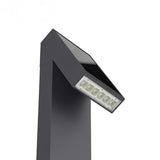
Strata Pro glass monocrystalline solar panel
Glass
Glass Monocrystalline Panel
5V / 1.4W monocrystalline cells under real glass. Plastic covers haze under UV and lose light for good. Glass does not, so it still charges in year three.
DOES NOT YELLOW
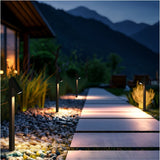
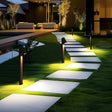
Strata Pro solar pathway lights lining a front yard walkway at night, viewed from the second story
7.4Wh
Lithium-Ion Reserve
3.7V / 7.4Wh Li-ion holds near full capacity in cold. NiMH cells in budget lights are down 30 to 50%. Why they work in August and go dark in January.
COLD RATED
Strata Pro IP65 sealed solar pathway light
IP65
Sealed Against the Weather
Sealed against driving rain, dust, snow, and sprinkler overspray. Not "water resistant." IP65, specifically.
SEALED
Strata Pro solar pathway light staked beside a stacked stone entry walk
2 Mounts
Stake and Surface Mount
Aluminum ground stake and a surface mount kit with screws and anchors, both in the box. Soil, deck, concrete, porch steps. Nothing else to buy.
BOTH INCLUDED
3-CORE INTELLIGENCE

Three Systems.
One Mission: Never Go Dark.

While generic path lights run at full brightness until sudden death, the Strata Pro™ systematically budgets its stored power across three systems, every night, so dawn never catches it dark.

01
ADAPTIVE LIGHTING

Adaptive Lighting System

Reads stored charge in real time and paces output against how much of the night is left. On a full charge after a sunny day it runs high through the evening. After three grey days it starts conserving earlier, quietly, so it is still glowing at dawn instead of blazing at nine and dark by midnight. You never see it happen. That is the point.

DUSK TO DAWN
02
POWER MANAGEMENT

Power Management System

Manages the charge and discharge cycle to protect the lithium cell across years, not months. Prevents overcharge in high summer sun, controls the discharge curve so the battery is never run flat, and keeps capacity from bleeding away the way it does in a light with no management at all. This is the difference between a battery that is at 90% of capacity in year three and one that is at 40.

CELL LONGEVITY
03
THERMAL CONTROL
60-80°
OPTIMAL
115°
-10°

Thermal Control System

Standard across the entire Pro-Line. Insulates the LED array and battery cell from temperature swings in both directions, protecting against heat-driven LED degradation in summer and cold-driven capacity loss in winter. Maintains performance whether it is 115 degrees in Phoenix or below freezing in Minneapolis. This is why the Strata Pro is still running in year three while budget lights have already been replaced twice.

ALL-CLIMATE
CONSTRUCTION

Powder-Coated Aluminum. Tempered Glass.
A Head That Runs Cool.

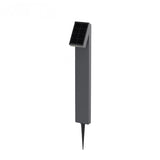
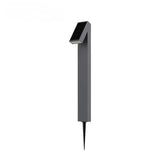
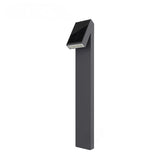
Pick one up and the argument is over. A twenty-two inch powder-coated aluminum body under a tempered glass panel, 2.2 pounds in your hand. The finish is powder coat, not paint, so it does not chalk or flake off the way sprayed aluminum does after two summers. The panel is real glass over monocrystalline cells, which is the specification professional landscape fixtures use, and it is the reason this light is still charging at the same rate in year three. The stake is heavy-duty aluminum, not the hollow plastic spike that snaps the first time you push it into hard soil.

22" x 4.25" x 2.85"Dimensions
2.2 lbsNet Weight
Aluminum + GlassBody and Panel
WHERE IT GOES

Six Places This Light Earns Its Keep.

Strata Pro solar light along a front walkway
WALKWAY

Front Walkway

The stretch from the driveway to your door. Alternate sides and the path becomes the first thing people notice.

Strata Pro solar light along a driveway edge
DRIVEWAY

Driveway Edge

Mark the line so nobody puts a wheel in the lawn again. 500 lumens holds a driveway's width. Most path lights cannot.

Strata Pro surface mounted on deck steps
DECK & STEPS

Deck and Porch Steps

Surface mount straight into deck boards. Every step edge visible without running a single wire under the framing.

Strata Pro staked in garden bed border
GARDEN

Garden Beds and Borders

Stake it in mulch or soil. Warm light across planting at CRI 93+ keeps green looking green instead of grey.

Strata Pro lights along a poolside walkway
POOLSIDE

Poolside

Ring the edge of the entertaining space. Warm, low, continuous, with no fixture pointed at anyone's eyes.

Strata Pro lights along a commercial HOA walkway
COMMERCIAL

Commercial and HOA Walkways

No trenching, no permit, no electrician, no walkway shutdown. LED binning keeps color consistent across every fixture.

The Strata Pro is one fixture in the full True Lumens™ solar landscape and garden lighting collection.

SIDE BY SIDE

Strata Pro vs. the Light You Already Own.

Strata Pro™
Output500 True Lumens, measured
LEDsGerman Osram, CRI 93+
Color3000K warm white, color-binned
Solar panelGlass monocrystalline
Battery cells3.7V / 7.4Wh Li-ion
Output controlAdaptive, dusk to dawn
HousingAluminum body + tempered glass panel
MountingStake + surface, both included
RatingIP65
Warranty24 months, US support
$179.99
Per light. Still in the ground five years from now.
Typical “Premium” Solar Path Light
OutputAdvertised 100-300. Delivers 10-30 within weeks.
LEDsGeneric chips, CRI 60-70
ColorWhatever blue-white the batch produced
Solar panelPlastic lens, hazing within weeks in full sun
Battery cellsNiMH, down 30% by week six
Output controlOn until the battery is flat
HousingPlastic, brittle after one season
MountingOne plastic spike
Rating"Weather resistant"
Warranty30 days at best, overseas
$50-80 each
A fresh one every couple of months, and every one of them is back to 10 to 30 lumens within weeks. Replacing it never buys more than a few more weeks.
HOW MANY DO YOU NEED

The Spacing Decides the Look.
Not the Light.

Every guide tells you a spacing figure and stops there. Here is what they leave out. At wider spacing you get separate pools of light with dark gaps between them, and the path reads as dotted. At tighter spacing those pools overlap, the gaps close, and the walkway glows continuously. Both are correct installations. One of them is the one people slow down to look at.

1. Describe your run
2. Pick the look, add the lights
--
Standard Spacing (8-10 ft)
Separate, defined pools of light. Costs less today.
--
Continuous Glow (6-8 ft)
Overlapping light, no dark gaps. The result most people picture.

Seen enough?

24-Month Warranty 30-Day Returns Ships from Corona, California
INSTALLATION

Two Ways to Install. Both in the Box.

Either path takes about 15 minutes per light, box to installed.

Path A

In the Ground

Push the heavy-duty aluminum stake into soil, mulch, or a planting bed. No digging, no tools. Position the panel with a clear view of the sky and away from any porch light or street lamp, because the photocell will read nearby artificial light as daylight and refuse to switch on.

Path B

On the Surface

Use the included mount kit with the supplied screws and anchors. Wood decks, concrete, pavers, driveways, porch steps. A drill and a screwdriver. Nothing else, and nothing else to buy.

Let it charge in direct sun for two to three days before the first night, so it starts with a full reserve rather than climbing out of a hole. Pick a brightness mode. That is the last time you touch it.

No wires. No electrician. No permit. No monthly bill.

TECHNICAL DETAILS

Everything Under the Hood

Brightness500 Lumens
Brightness Modes25% / 50% / 75% / 100%
Adaptive DimmingYes, automatic across the night
LED TypeHigh-Performance German Osram
CRI93+
Color Temperature3000K Warm White
Battery3.7V / 7.4Wh Li-ion
Solar Panel5V / 1.4W Glass Monocrystalline
Weatherproof RatingIP65
Housing MaterialPowder-Coated Aluminum Body, Composite Lamp Head, Tempered Glass Panel
Dimensions22" x 4.25" x 2.85"
Net Weight2.2 lbs per unit
OperationDusk to Dawn (Photocell)
MountingAluminum Ground Stake or Surface Mount Kit
Warranty24 Months, US-Based Support
What's in the Box1x Strata Pro, 1x Aluminum Ground Stake, 1x Surface Mount Kit, Installation Guide
THE BRAND BEHIND IT

Building Solar That Outlasts the Category.
Since 2016.

US-based support. A 24-month warranty we actually honor. And German Osram LEDs in every Pro-Line fixture we ship.

COMMON QUESTIONS

The Questions People Ask Before They Buy

Straight answers, including the two that cost us sales: shade and deep winter.

Strata Pro runs 8 to 12 hours on a full charge, and it does not switch off at the end of that window: adaptive output steps the brightness down and the light stays usable until dawn. What makes that different from the runtime numbers printed on other path lights is the adaptive system underneath it. Most solar path lights run at full output until the battery is empty, which on a partly charged day means dark by ten. The Strata Pro reads stored charge against how much of the night is left and paces its output accordingly, running brighter in the early evening and easing down toward morning. The practical result is a light that is still glowing at five in the morning after a grey week, instead of one that was brilliant at eight and gone by eleven.

Yes, 500 lumens lights the full width of a standard walkway and holds up along a driveway edge, roughly 20 times the 10 to 30 lumens most solar path lights actually measure within weeks of going outside. Those fixtures advertise 100 to 300 lumens, so the gap is measured output against the number printed on the box. Brightness is only half of it though. At CRI 93+ the light renders color accurately, so pavers look like stone and planting beds stay green instead of going grey. A high-CRI 500-lumen fixture looks dramatically better than a low-CRI fixture at the same number, because you are seeing detail rather than a bright patch.

Space Strata Pro lights 8 to 10 feet apart for standard coverage, or 6 to 8 feet apart for a continuous, overlapping glow with no dark gaps. At standard spacing a 40-foot walkway lit on one side takes 5 to 6 lights. Wider spacing gives an open, pooled-light look with visible gaps between fixtures; tighter spacing reads as one unbroken line of light. Both are correct installations, the choice is the effect you want, and the Spacing Planner on this page turns your exact run length into a count for either layout.

At the standard 8 to 10 foot spacing, a 40-foot walkway lit on one side takes 5 to 6 lights, and lighting both sides doubles the count; the tighter 6 to 8 foot continuous-glow spacing adds roughly one light for every three at standard. The planner on this page gives the exact number for your footage. Most buyers underestimate on the first order and add more within a few weeks of seeing the first run in the ground, because a partial installation reads as incomplete in a way a full one never does. Ordering enough to finish the run at once is almost always the better decision.

Yes, pricing steps down automatically as the order grows: 5% off at 2 or more lights, 10% off at 4 or more, and 15% off at 8 or more, applied automatically at checkout with no code to enter. The tiers exist because pathway lighting is bought in runs, and a complete run is what makes the installation look finished. At the 8-light tier the per-light price drops to its lowest point, which for a 40 to 60 foot walkway is usually the exact quantity the spacing math calls for anyway. The quantity selector on this page shows the per-light price at every tier before anything goes in the cart.

Yes, because the glass monocrystalline panel keeps charging usefully on overcast winter days, converting 18 to 22% of incoming light against 12 to 15% for the polycrystalline panels used in budget path lights, and the 7.4Wh lithium-ion cell holds close to full capacity in cold, where NiMH batteries are already down 30 to 50% by freezing. The honest nuance: in the deepest weeks of December and January in far northern states, when daylight is eight hours and cloud cover is persistent, any solar light including this one may show reduced output. The adaptive system handles that better than a simple circuit can, and a few days switched off rebuilds the reserve completely.

The four modes set maximum output at 25%, 50%, 75%, or 100%, and the adaptive dimming system runs underneath whichever one you choose. Most owners settle on 50%, which reads the path edge clearly and leaves real margin in the battery after a grey stretch. Go to 75% or 100% for wider spacing, longer runs, driveways, or high-sun regions where the panel banks more charge each day than the night can spend. Drop to 25% for tight spacing where the lights overlap, or where you want the path present rather than bright. You can change it at any time, and each fixture is set independently, so a run can step down as it moves away from the house.

Yes, and both mounting methods are included in the box. The heavy-duty aluminum ground stake handles soil, mulch, and planting beds with no tools at all. The surface mount kit, with screws and anchors supplied, handles wood decks, concrete, driveways, porches, and steps using a drill and a screwdriver. Most path lights in this category ship with a plastic spike and nothing else, which means a deck or a concrete walkway is either an adapter purchase or simply not an option. You do not have to decide which one you need before ordering, and you can change your mind later without buying anything.

A pathway light casts light down and outward across the ground to illuminate a walking surface, while a bollard casts light in a wider circle at a lower height and works as much as a visual marker as a source of illumination. The Strata Pro is a pathway light at 22 inches, built to lay useful light across the width of a walkway or driveway edge. The True Lumens™ Pro-Line Bollard is a bollard, shorter and rounder, made to mark a boundary and create ambient glow at a lower output. If you are lighting a surface you walk on, you want the pathway light. If you are marking an edge or a bed line, you want the bollard. Plenty of properties use both.

No, 3000K reads as warm and inviting rather than yellow and is what almost every high-end hotel walkway you have admired is running. It flatters the materials that outdoor spaces are actually built from: brick, cedar, natural stone, mulch. The color people describe as cheap and yellow is usually low-CRI light, not warm light. At CRI 60 to 70 a warm chip renders muddy. At CRI 93+ the same warmth renders rich. The Strata Pro is 3000K at CRI 93+, which is the combination professional landscape lighting is spec'd to.

Not on its own, because what determines how well a solar light charges is the cell underneath, not the cover over it. The Strata Pro uses a commercial-grade monocrystalline cell, the same grade used in rooftop solar, which converts 18 to 22% of the daylight that reaches it against 12 to 15% for the polycrystalline cells in budget lights, and keeps converting in weak winter sun where lower-grade cells fall away. Tempered glass matters because it keeps that advantage intact: it wipes clean, and it will not haze or yellow under years of UV the way an untreated plastic cover can, which costs a hazed panel 20 to 40% of its light transmission in a single season. A glass cover tells you how a panel is protected. It does not tell you how well that panel performs. The specification that answers that is the cell type underneath it.

Two things: CRI 93+ color accuracy, and tight color binning so every fixture in a run glows at exactly the same color temperature. High CRI means materials in your landscape look like themselves instead of washing out to grey under a low-CRI chip. Binning matters enormously on a pathway product specifically: with unbranded chips the color drifts between units, and a row of six lights ends up with one warm, one greenish, one bluish, which is the single most visible tell of a cheap installation. Osram has been manufacturing precision light sources for well over a century, and these chips are the same family used in automotive headlights, surgical lighting, and architectural installations where color accuracy is not optional.

Yes, the Strata Pro is rated IP65, which means it is fully sealed against dust and protected against water jets from any direction, including driving rain and sprinkler overspray. That is a specific standard, not a marketing phrase, and it is a meaningful step above the IP44 rating that covers only light splashing. The body is powder-coated aluminum under a tempered glass panel, with no thin brittle shell to crack after a season of UV and freeze-thaw cycling. The lithium-ion cell holds usable capacity well below freezing, which is where the NiMH batteries in budget lights lose 30 to 50% of theirs. It is built for year-round outdoor service in any US climate.

No, none of the three, because there is no electrical connection of any kind. The panel charges the internal lithium-ion cell during daylight and the photocell switches the light on at dusk and off at dawn with no timer, no app, and no configuration. Because nothing connects to your home's electrical system, solar path lights fall outside what residential electrical permits regulate, and typical installs need no permit at all. For scale, a licensed electrician running low-voltage landscape lighting along a standard driveway typically quotes $1,800 to $3,500 in labor and materials, before you account for trenching across your lawn, transformer replacement in year seven, or the underground wire repairs that follow rodent damage. The Strata Pro eliminates that entire category of cost and disruption.

Full coverage on defects in materials and workmanship for 24 months, including LED failure, battery performance below rating, and panel degradation beyond normal parameters. If a Strata Pro fails under normal use in that window, contact our US-based support team in Corona, California, and we replace it. It does not cover impact damage, water intrusion from an improper surface mount installation, or a unit installed in permanent shade where it cannot charge. What it is not: a store credit workaround, a repair queue, or a process that routes you to seller messages on a marketplace and goes nowhere. That is the standard warranty experience in this category and it is the reason most brands can afford to offer one.

The Strata Pro is 22 inches tall with a 4.25 by 2.85 inch footprint, and next to a walkway it reads as architectural rather than oversized. That is taller than the 14 to 18 inch fixtures most solar path lights ship at, and the height is deliberate, doing two things. Raising the source spreads light across a wider band of ground, which is why a taller fixture covers a walkway edge to edge where a short one puts a bright circle at its own base. It also lifts the light above low planting, mulch, and snow, so the beam is not blocked by the first thing that grows or falls in front of it. Up close it reads closer to a professionally installed fixture than a garden ornament.

The Strata Pro needs several hours of direct sun on its panel each day, so a spot in full, permanent shade is not a workable location for it. Its glass monocrystalline panel converts 18 to 22% of incoming light against 12 to 15% for the polycrystalline panels in budget fixtures, so it makes far better use of bright shade, dappled light, and overcast days. If your path gets morning or afternoon sun, it will charge. If a stretch never sees direct sky, place the fixtures on the sunnier sections and let the light carry into the shaded one. Installs in permanent full shade fall outside warranty coverage, which is why we say it plainly here.

The Strata Pro is built for five or more years in the ground; budget solar path lights are typically replaced every couple of months. The difference is not the LED, it is the panel and the battery. A plastic panel lens hazes over in its first year and permanently costs the panel 20 to 40% of its light transmission, and NiMH cells fade hard with every winter. The Strata Pro's tempered glass panel does not haze, its lithium-ion cell holds capacity year over year, and it is backed by a 24-month warranty with US-based support in Corona, California.

Place it in direct sun for two to three days before its first night, so the battery starts from a full reserve instead of climbing out of a hole. After that the panel recharges it every day and the photocell handles on and off automatically, with no timer, no app, and nothing to configure. If the first nights seem short, that is almost always a partial first charge rather than a defect, and a few sunny days resolves it.

The most common cause is a nearby porch or street light: the photocell reads that artificial light as daylight and keeps the fixture off. Move the light away from artificial sources, confirm the panel gets direct sun during the day, and give it two to three days of charge before judging it. If a Strata Pro still will not switch on after that, contact our US-based support team, that is what the 24-month warranty is for.

One side is the standard installation, and it lights a walkway of typical width edge to edge because the Strata Pro throws its wash across the full walking surface. Light both sides when the path is wider than about five feet, when it curves enough that one row cannot trace it cleanly, or when you want the formal, symmetrical look of a resort entrance rather than everyday guidance. Both-side runs double the count and read as deliberately designed. The planner on this page gives the exact number either way, and starting with one side leaves you free to add the second row later, since every light is independent.

No, the 7.4Wh lithium-ion cell is sealed into the housing and is not user-replaceable. It is rated to stay in service beyond five years, and the 24-month warranty covers failures before then.

A 3.7V / 7.4Wh commercial-grade lithium-ion pack with its own battery management system. The pack stores the energy. The management system decides how that energy is treated: it holds charging inside a safe ceiling on a long summer day and halts discharge at a safe floor on a long winter night, so the cells are never worked past their limits at either end. That protection is what inexpensive path lights leave out, because it is a real cost on a product built to a price. It is also the single biggest reason most solar light batteries are noticeably weaker after one season and finished after two. Lithium-ion also holds close to full capacity in cold, where the NiMH cells in budget lights are already down 30 to 50% by freezing.
READY WHEN YOU ARE

Your Path Deserves This Light.

Pathway light is bought by the run, not by the piece. Volume discounts start at 2 lights.

Pro-Line Pathway Series

Strata Pro™ Solar Pathway / Outdoor Landscape Light | Dusk-Dawn | 500LM

500 True Lumens. German Osram LEDs. 3000K Warm White. Four brightness modes with adaptive dimming. Glass monocrystalline panel. IP65. Stake and surface mount both included.

★★★★★5.0 · 4 verified reviews
$279.99$179.99
SAVE $100.00
Volume Discount Chart
1 light$179.99 / light
2-3 lights 5% off$170.99 / light
4-7 lights 10% off$161.99 / light
8+ lights 15% off$152.99 / light

💡 Not sure how many? The Spacing Planner above gives you the number for your exact run.

In Stock · Ships from Corona, California
Free Shipping over $100
24-Month Warranty
30-Day Returns
Ships from Corona, California